KFC
KFC — Kentucky Fried Chicken — is the world’s second-largest restaurant chain by sales, after McDonald’s, with almost 32,000 outlets in 150 countries. Its founder licensed his first franchise at sixty-two, and went into the business full-time at sixty-five, after a new highway took away his customers.
The Road That Moved Away
By the mid-1950s Harland Sanders owned a successful roadside restaurant and motel in Corbin, Kentucky. Nearly all of its customers were travellers on the main highway.
Then the route planned for the new Interstate 75 bypassed his property. A business that lived on passing traffic had nothing left to live on, and Sanders, at sixty-five, sold up. Afterwards he had his savings and a Social Security cheque of $105 a month.
Most people at that age would have stopped. Sanders drove from town to town instead, offering restaurant owners a deal: he would teach them to cook his chicken, and they would pay him a small fee for every chicken they sold. It was not the start of his working life. It was the start of KFC.
A Service Station in North Corbin
Sanders was born in Indiana in 1890. His father died when he was five, his mother went to work in a canning factory, and he left school early for a long run of jobs, among them farmhand, railway worker, insurance salesman and service-station operator.
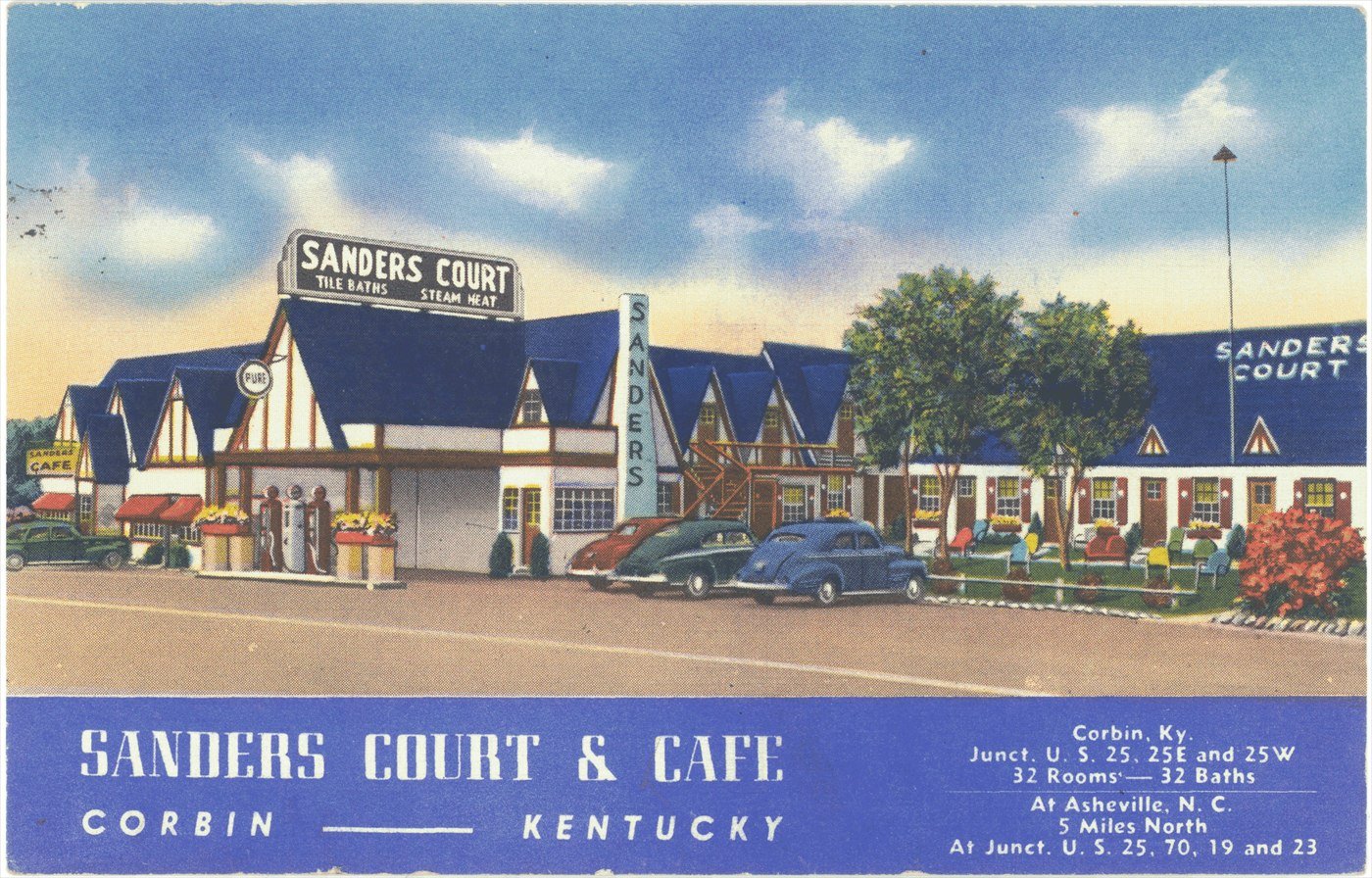
In 1930, early in the Great Depression, the Shell Oil Company offered him a service station in North Corbin, on U.S. Route 25 at the edge of the Appalachians, rent-free in return for a share of its sales. He began cooking for the travellers who stopped for fuel — at first in his own living quarters, then in a restaurant that grew into Sanders Court & Café, with a motel attached.
The food became the business. In 1935 the governor of Kentucky, Ruby Laffoon, made Sanders an honorary Kentucky Colonel — a title he would later turn into a costume, and the costume into a trademark.
A Pressure Fryer and Eleven Herbs and Spices
Chicken fried properly in a pan took around half an hour, too long for customers with a journey ahead of them. In 1939 the first commercial pressure cookers came on the market, mostly for steaming vegetables. Sanders bought one and adapted it to fry chicken under pressure, which cut the cooking time dramatically.
In July 1940 he settled on the seasoning that became the Original Recipe, a blend of eleven herbs and spices. It has been guarded as a trade secret ever since, and is among the most famous in the food industry.
The two inventions mattered in different ways. The seasoning was the product. The pressure fryer was the system — a way of making the same chicken quickly and consistently, which is what would eventually let strangers make it in kitchens Sanders had never seen.
The First Franchise Was in Utah
The first restaurant to sell Sanders’s chicken under licence was not in Kentucky. In 1952 he franchised the recipe to his friend Pete Harman, who ran one of the biggest restaurants in South Salt Lake, Utah.
The name did not come from Sanders either. Harman hired a sign painter, Don Anderson, who came up with “Kentucky Fried Chicken”. For a restaurant in Utah, food from Kentucky sounded distinctive, even a little exotic, with a suggestion of Southern hospitality. In 1957 Harman also introduced the cardboard bucket.
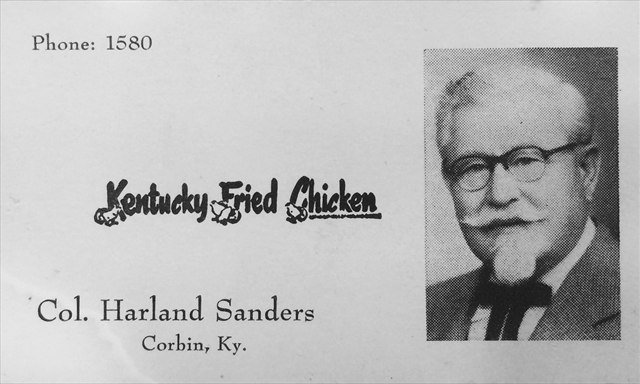
In 1950 Sanders had been made a colonel again by a later governor, Lawrence Wetherby, and he began to dress the part: a goatee, a string tie and, in time, the white suit. He understood earlier than most marketers that a face could sell food. By the early 1960s the Colonel was the brand, and also its travelling salesman.
Selling at Seventy-Three
Growth overwhelmed him. In 1964, aged seventy-three, Sanders sold the company to a group of investors led by John Y. Brown Jr. and Jack Massey for $2 million, and stayed on as its public face.
The new owners were far better at scale than he had been. In July 1971 Brown sold Kentucky Fried Chicken to the drinks and food group Heublein for $285 million.
Sanders did not accept the corporate era quietly. He complained in public that cost-cutting had ruined the food, and saved particular contempt for the simplified gravy, which he called slop with a “wallpaper taste”. The company kept his face on the buckets regardless. He died on 16 December 1980, still the most recognisable part of a business he no longer owned.
Heublein, Reynolds, PepsiCo, Yum
After that the chain changed hands as a corporate asset. Heublein was bought in 1982 by R.J. Reynolds, the tobacco and food group, which in July 1986 sold KFC to PepsiCo for $850 million. In 1991 the company formally adopted the initials it was already known by.
In 1997 PepsiCo spun off its restaurants — KFC, Pizza Hut and Taco Bell — as a separate company, Tricon Global Restaurants, later renamed Yum! Brands. KFC has been part of Yum ever since.
The owners mattered less than the model beneath them. KFC’s restaurants are overwhelmingly run by franchisees, who invest their own money and pay for the brand, the recipe and the system. That is how a chain reaches tens of thousands of locations without owning most of them.
Beijing, 1987
KFC’s most consequential decision after the Colonel’s death was to go where American fast food had not.
In November 1987 it opened a restaurant in Beijing, becoming the first Western restaurant chain in China. It adapted the menu with rice bowls, noodle dishes and chicken wraps in the style of Peking duck, and grew into the country’s largest fast-food chain. In 2016 Yum spun off its Chinese business as a separate listed company, Yum China, which runs KFC there under licence.
Japan supplied a stranger success. Since an advertising campaign in the 1970s, eating KFC on Christmas Eve has become a national habit, with families ordering their buckets weeks ahead.
The Colonel Without the Colonel
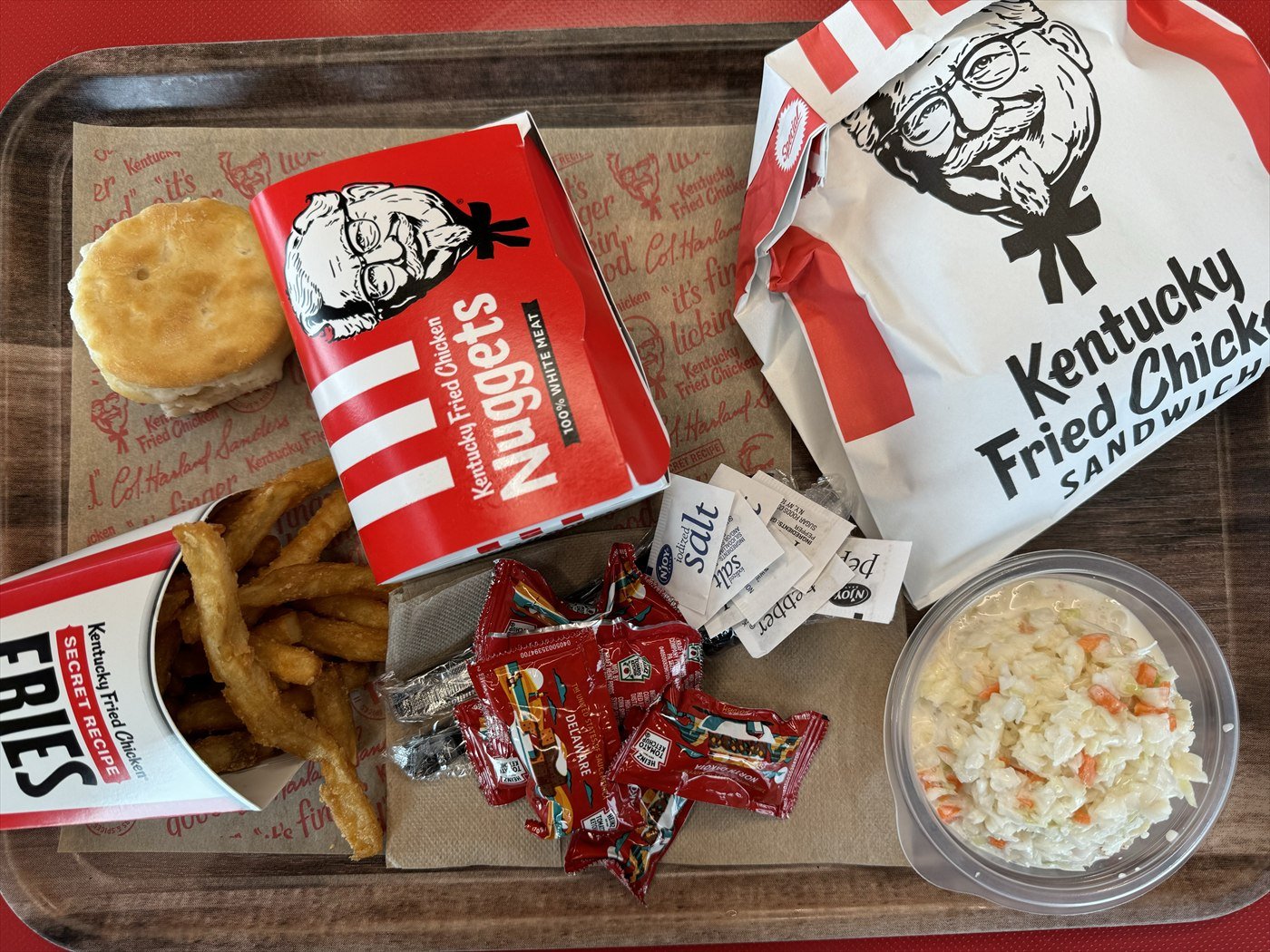
Sanders is still on the packaging, and actors still play him in advertisements. The company now treats him less as a real man than as a mascot — exactly what he spent his last years complaining about, and exactly what has kept the brand recognisable.
KFC had about 31,980 restaurants in 150 countries by September 2025, and is the world’s second-largest restaurant chain by sales. Its headquarters has moved from Louisville, Kentucky, to Plano, Texas, and in June 2026 it began a global refresh of its branding, restaurant designs and menus. Scott Mezvinsky is chief executive.
Its parent, Yum! Brands, reported revenue of $8.2 billion and net income of $1.56 billion for 2025. Those numbers are far smaller than what customers spend at KFC, because most of that money goes to the franchisees who own the restaurants.
What Could Still Go Wrong
Three things are worth setting down.
A franchise is only as good as its worst kitchen. In February 2018 a change of delivery contractor in the United Kingdom left hundreds of restaurants without chicken and forced them to close for days. In June 2025 KFC closed all its restaurants in Denmark and dismissed the franchisee after a television programme showed staff falsifying food-safety dates. The brand pays for failures it does not directly control.
Promises on welfare. KFC committed to higher animal-welfare standards in several markets, including slower-growing chicken breeds by 2026; by 2024, only about 1 per cent of its chickens reportedly came from such breeds. Commitments with dates attached get checked.
Health and habit. Fried chicken sits on the wrong side of long-running changes in diet, and the chain’s growth increasingly depends on countries where it is still relatively new.
A new road took the Colonel’s customers away in the 1950s. He answered by taking the recipe to the customers instead — which is still, in the end, what KFC does.
Common Questions
Who founded KFC?
How old was Colonel Sanders when he started KFC?
What is in the KFC Original Recipe?
Who owns KFC?
How many KFC restaurants are there?
When did KFC open in China?
How This Was Written
Figures are as at the date of publication. KFC does not report separately from Yum! Brands, so the restaurant count is the chain’s and the revenue is its parent’s; corrections are welcome.
Photography is public domain or CC0 and is credited in the site’s image credits. Corrections: commissions@99founder.com.