BMW
BMW — Bayerische Motoren Werke, the Bavarian Motor Works — builds BMW and Mini cars, Rolls-Royce motor cars and BMW motorcycles. It began by making aircraft engines. In 1959 its own management proposed selling it to its great rival, Daimler-Benz.
The Meeting of December 1959
By the end of the 1950s BMW was losing money on almost everything it built. Its large luxury saloons sold slowly, and the tiny bubble cars that kept its factory busy earned almost nothing on each sale.
Management’s answer was to sell. The proposal was a takeover by Daimler-Benz, the maker of Mercedes, which would have made BMW a subsidiary of the company it had spent decades competing against.
At the shareholders’ meeting in Munich on 9 December 1959 the plan fell apart. Small shareholders and the company’s dealers objected so strongly that it could not go through. What happened next — and whose money paid for it — decided what BMW became.
Aircraft Engines and a Borrowed Name
BMW’s origins lie in Munich’s aircraft industry during the First World War, and its early history is a tangle of companies and names. In 1913 the engineer Karl Rapp founded Rapp Motorenwerke to build aero engines, and in 1917 that business was renamed Bayerische Motoren Werke. Separately, an aircraft maker formed in 1916, Bayerische Flugzeugwerke, later took over the BMW name and its engine business. BMW dates its founding to 7 March 1916.
The engine that made the name was the BMW IIIa, a six-cylinder aero engine designed in 1917 by Max Friz. It performed unusually well at altitude, and it gave the young company a reputation for engineering before it had built a single road vehicle.
Then Germany lost the war. The Treaty of Versailles banned German aircraft-engine production, and a company that existed to make aero engines had to find something else to make. For a time it built brakes for railway wagons.
Motorcycles, a Licensed Car and a Misread Logo
In 1923 BMW introduced its first motorcycle, the R32, built around a flat twin engine. Motorcycles have been part of the business ever since.
The first BMW car was not really a BMW. In 1928 the company bought Fahrzeugfabrik Eisenach, which built the British Austin 7 under licence as the Dixi. The first car sold as a BMW, the 3/15, was a Dixi with a new badge.
That badge carries a small myth of its own. The blue-and-white roundel is often said to show a propeller spinning against the sky. It does not. It grew out of Rapp’s earlier company logo, with quarters echoing the colours of Bavaria; the propeller story most likely comes from a 1929 BMW advertisement that placed the logo on a rotating propeller. The company was content to let the story fly for decades.
The War and What It Cost
Under the Nazi regime BMW returned to its first trade and became one of Germany’s most important makers of aircraft engines. Like much of German armaments production, it relied heavily on forced labourers and concentration-camp prisoners — a history the company has since acknowledged.
The war left the business in ruins. Its Munich works had been bombed, the car factory at Eisenach lay in the Soviet zone and was lost, and for a time BMW was not permitted to build vehicles at all. It survived by making household goods such as pots and pans, and bicycles.
Bubble Cars and a Near Sale
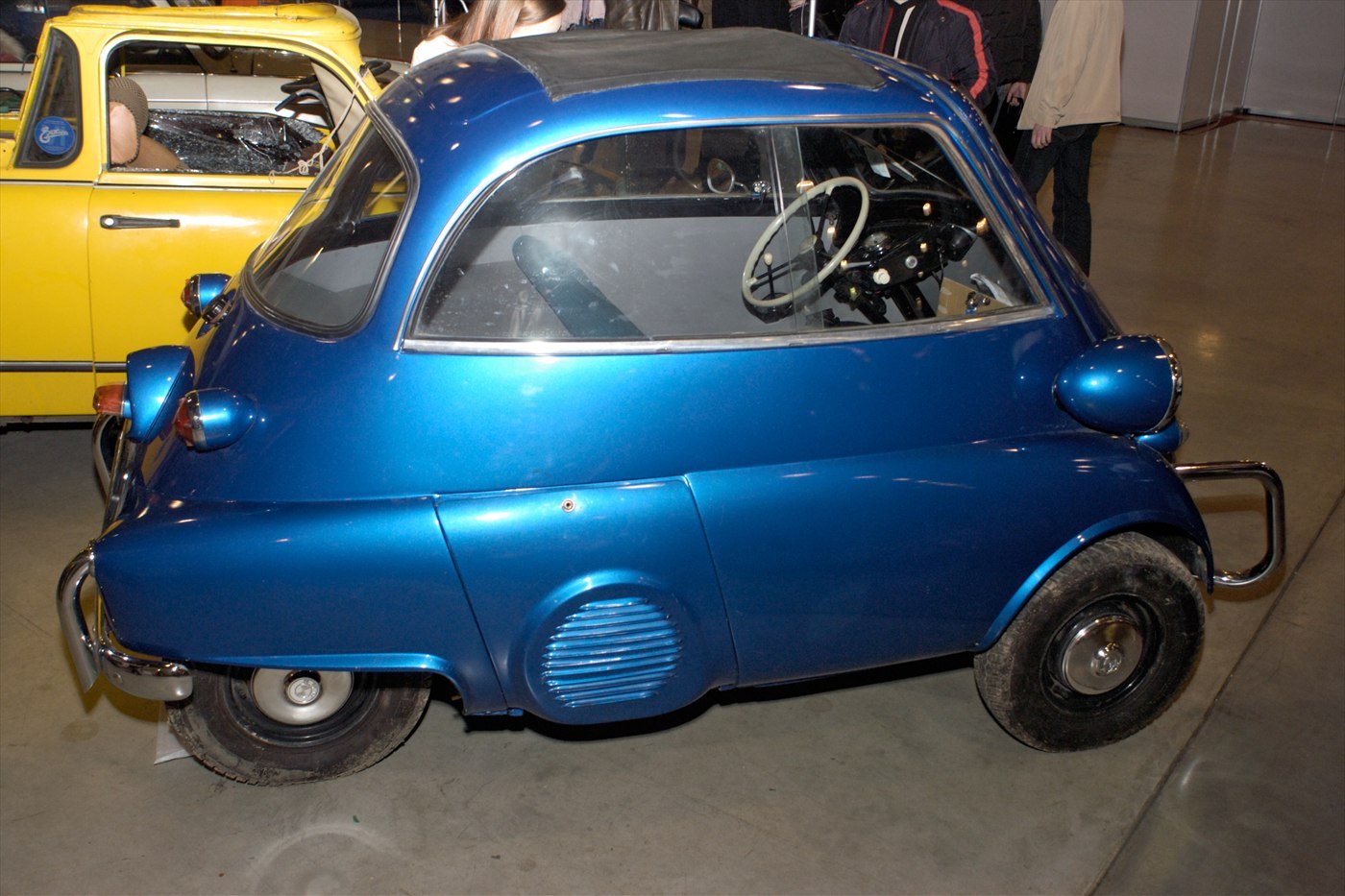
When car production resumed, BMW made two mistakes at once. It built large, expensive saloons that few Germans in the 1950s could afford, and in 1955 it began producing the Isetta, a tiny bubble car built under licence and entered through a door in its front.
The Isetta sold well. It simply did not make enough money. By 1959 BMW was in serious financial trouble, and its management put forward the sale to Daimler-Benz.
After the December meeting blocked the sale, the industrialist Herbert Quandt and his half-brother Harald chose to invest instead. Herbert Quandt substantially raised his stake, backed the new mid-sized model BMW was already planning, and kept the company independent.
The Quandt money has a history of its own. Herbert’s father, Günther Quandt, joined the Nazi Party in 1933 and made a fortune arming the Wehrmacht, including through businesses taken from Jewish owners under duress; wealth built in that period is what later allowed his son to buy into BMW. The family, still BMW’s largest shareholder, commissioned an independent study of that history, published in 2011.
The New Class
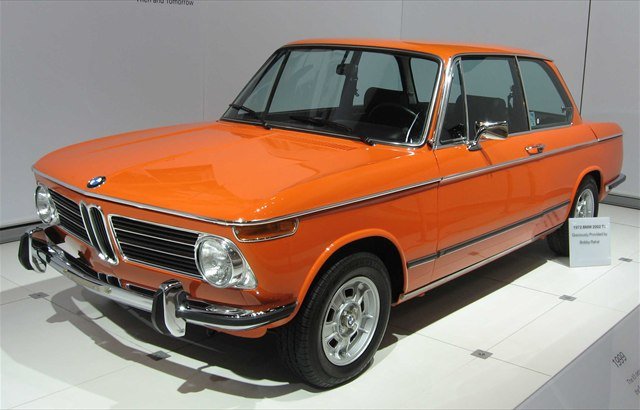
The car that saved BMW was the BMW 1500, launched in the early 1960s and known as the Neue Klasse — the New Class. It was a compact, sporty four-door saloon, and it found an almost empty space in the market between the small economy cars most people could afford and the large luxury cars few could.
That space became BMW’s identity. The New Class led to the 2002 of the late 1960s, the 3 Series of 1975 and the long-running promise of “the ultimate driving machine”: cars sold on how they felt to drive, not on size or comfort alone.
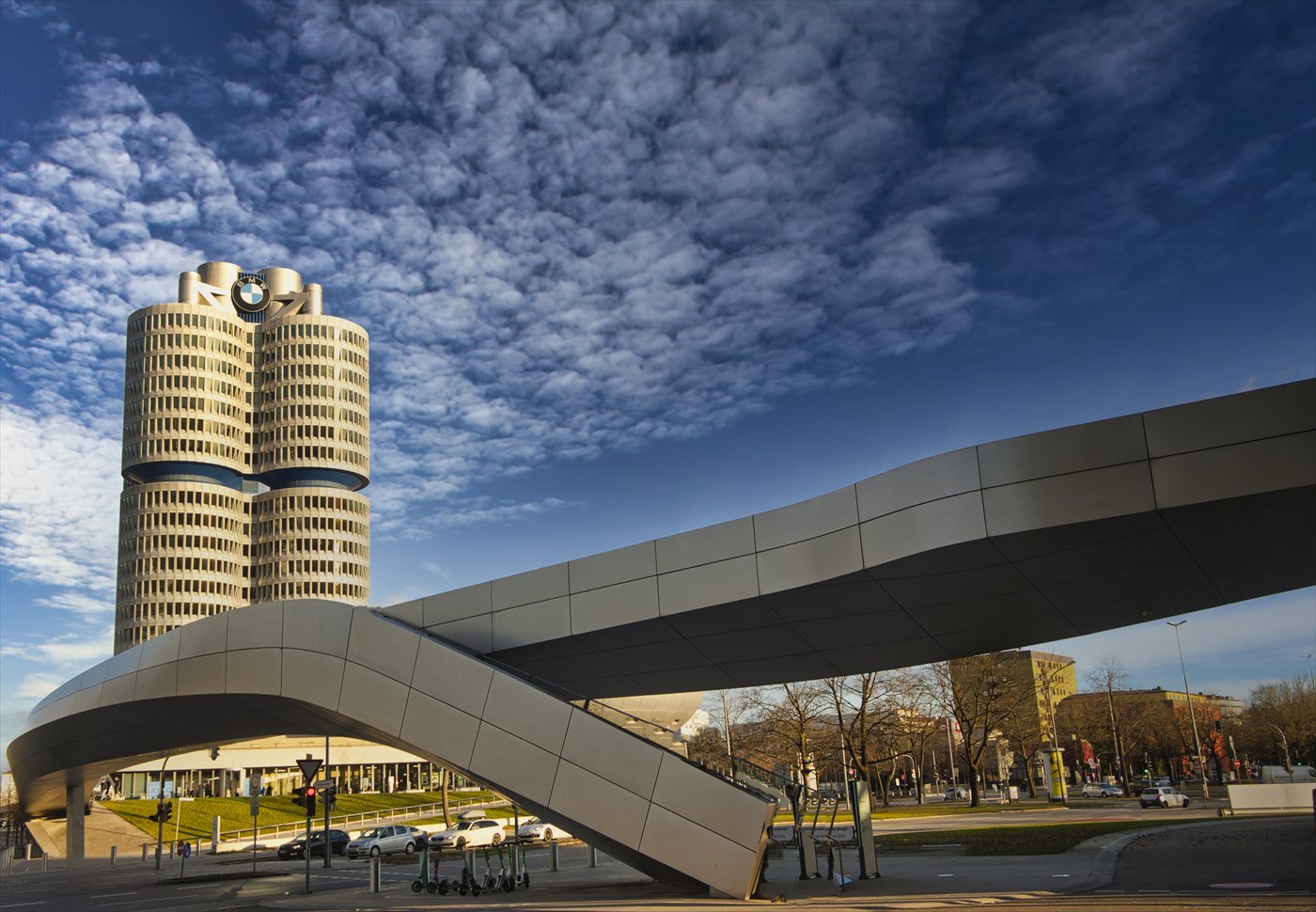
Under Eberhard von Kuenheim, who ran the company from 1970 to 1993, BMW grew from a regional manufacturer into an international one. In 1973 it moved into a new headquarters in Munich, a tower of four cylindrical sections that took the obvious nickname.
Rover, Mini and Rolls-Royce
BMW’s largest strategic mistake came in the 1990s. In 1994 it bought Britain’s Rover Group, planning to add cheaper and larger cars to its range without diluting its own brand. The takeover went badly and cost BMW heavily; the chief executive who had led it, Bernd Pischetsrieder, left in 1999.
In 2000 BMW sold most of Rover. Land Rover went to Ford — which in turn sold it, together with Jaguar, to Tata Motors in 2008. BMW kept one brand from the wreckage: Mini.
It relaunched the Mini in 2001 as a modern premium small car, built at a factory near Oxford, and turned an old British name into one of its most successful businesses. In 1998 it had also secured the Rolls-Royce name for cars, and since 2003 it has built Rolls-Royce motor cars at Goodwood in West Sussex. Out of a failed acquisition, BMW salvaged two of the most valuable brands in the industry.
The Electric Question
BMW moved early on electric cars and then, in the view of many critics, slowed down. Its first mass-produced electric car, the i3, went on sale in 2013 with a carbon-fibre passenger cell and an unconventional design. It won admiration and modest sales, and BMW spent the following years hedging — offering electric, hybrid and combustion versions of the same models rather than committing to one technology.
In 2025 it began a new generation of electric cars on a dedicated platform, named deliberately after the model that saved the company in the 1960s: the Neue Klasse. The first of them was the iX3.
In May 2026 Milan Nedeljković succeeded Oliver Zipse as chairman of the board of management. For 2025 the BMW Group reported revenue of €133.5 billion and net income of €7.5 billion, with about 154,500 employees.
What Could Still Go Wrong
Three risks are worth naming.
China. China became one of BMW’s most important markets, and Chinese buyers are turning to domestic electric-car brands that are cheaper, quicker to update and increasingly desirable. A premium German badge buys less there each year.
Timing. Hedging between electric and combustion engines protected profits while demand for electric cars stalled in some markets. If the shift accelerates, the new Neue Klasse will have to prove that BMW arrived in time rather than late.
The engineering reputation itself. BMW’s brand rests on trust in its engineering, and that trust has been tested — by a 2018 recall of more than 100,000 diesel cars in South Korea after engine fires, and by a European Commission fine in 2021 for colluding with other German carmakers over emissions-cleaning technology.
In December 1959 a room of small shareholders refused to let BMW become part of Mercedes. Sixty-six years later it is still competing with it, which is exactly what they wanted.
Common Questions
When was BMW founded?
Does the BMW logo show a propeller?
How was BMW saved in 1959?
Who owns BMW?
Which brands does BMW own?
What are BMW’s revenue and profit?
How This Was Written
Figures are as at the date of publication; corrections are welcome.
Photography is public domain or CC0 and is credited in the site’s image credits. Corrections: commissions@99founder.com.