IBM
IBM — International Business Machines — is one of the oldest technology companies in the world. It sells software, consulting and the mainframe computers that still run much of the world’s banking, and it is building quantum computers. In 1993 it lost more money than any American company had lost in a year.
The Year IBM Nearly Split Apart
In 1993 IBM reported a loss of about $8 billion, at the time the largest in American corporate history. The company that had defined computing for half a century was being overtaken by the personal-computer industry it had helped create.
The plan already under way was to break IBM into a set of smaller, independent businesses, each free to compete on its own. It had a certain logic, and most observers expected it to happen.
The board instead hired an outsider, Lou Gerstner, from the food and tobacco group RJR Nabisco. His most important decision was to stop the break-up. His argument — that large customers wanted one company able to make all the pieces work together — has shaped what IBM is ever since.
Four Companies and a Salesman
IBM was assembled rather than founded. On 16 June 1911 the financier Charles Ranlett Flint merged four companies — makers of punched-card tabulating machines, time clocks and commercial scales — into the Computing-Tabulating-Recording Company, based in Endicott, New York.
The most important of the four was the Tabulating Machine Company of Herman Hollerith, whose electric machines read information from holes punched in cards. Hollerith had sold the business to Flint for $2.3 million.
In 1914 the company hired a salesman named Thomas J. Watson, recently fired from the National Cash Register Company. Within a year he was president. On 14 February 1924 he renamed the company International Business Machines — a grand name for a firm of its size, first used by its Canadian subsidiary.
THINK, and the Contract of the Century
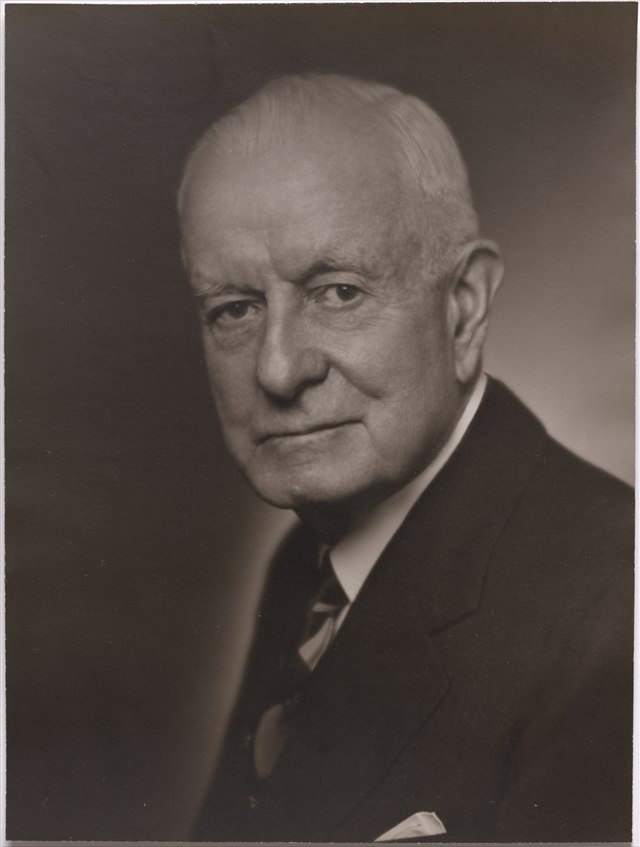
Watson brought with him a salesman’s culture: dark suits, company songs and a one-word slogan, THINK, hung on office walls. He also kept the practice of leasing machines rather than selling them outright, which gave IBM steady income and lasting relationships with the institutions that used its equipment.
His largest bet came in the Great Depression. While other companies cut back, IBM kept its factories running and built machines it could not yet sell. When the United States passed the Social Security Act in 1935, the government needed to track the earnings of millions of workers — “the biggest accounting operation of all time”, as it was described — and IBM was ready to supply the equipment at once.
It is one of the clearest early examples of a pattern that recurs in business history: carrying the cost of being ready for a demand that does not yet exist.
The Record in Germany
A full account has to include what IBM’s technology was used for in Europe.
From the 1920s the company held a majority stake in a German tabulating firm, Deutsche Hollerith Maschinen, known as Dehomag. From the early 1930s Dehomag supplied punched-card equipment that the Nazi regime used to run censuses identifying and categorising its citizens, and Nazi concentration camps operated departments equipped with Hollerith machines.
How much IBM’s New York headquarters knew and controlled, particularly once the war began, has been argued over for decades; the journalist Edwin Black set out the case against the company in IBM and the Holocaust. What is not in dispute is that the technology that made IBM’s fortune in America was also used to organise persecution in Germany.
Betting the Company on One Computer
By the early 1960s IBM dominated computing and had a problem of its own making: its computers were incompatible with one another. A customer who outgrew one model had to rewrite its software for the next.
Under Thomas Watson Jr., who had succeeded his father, IBM decided to replace its whole product line with a single family of machines sharing one design. The System/360 was announced on 7 April 1964. The cost of developing it was put at around $5 billion, and the project was widely described as IBM betting the company.
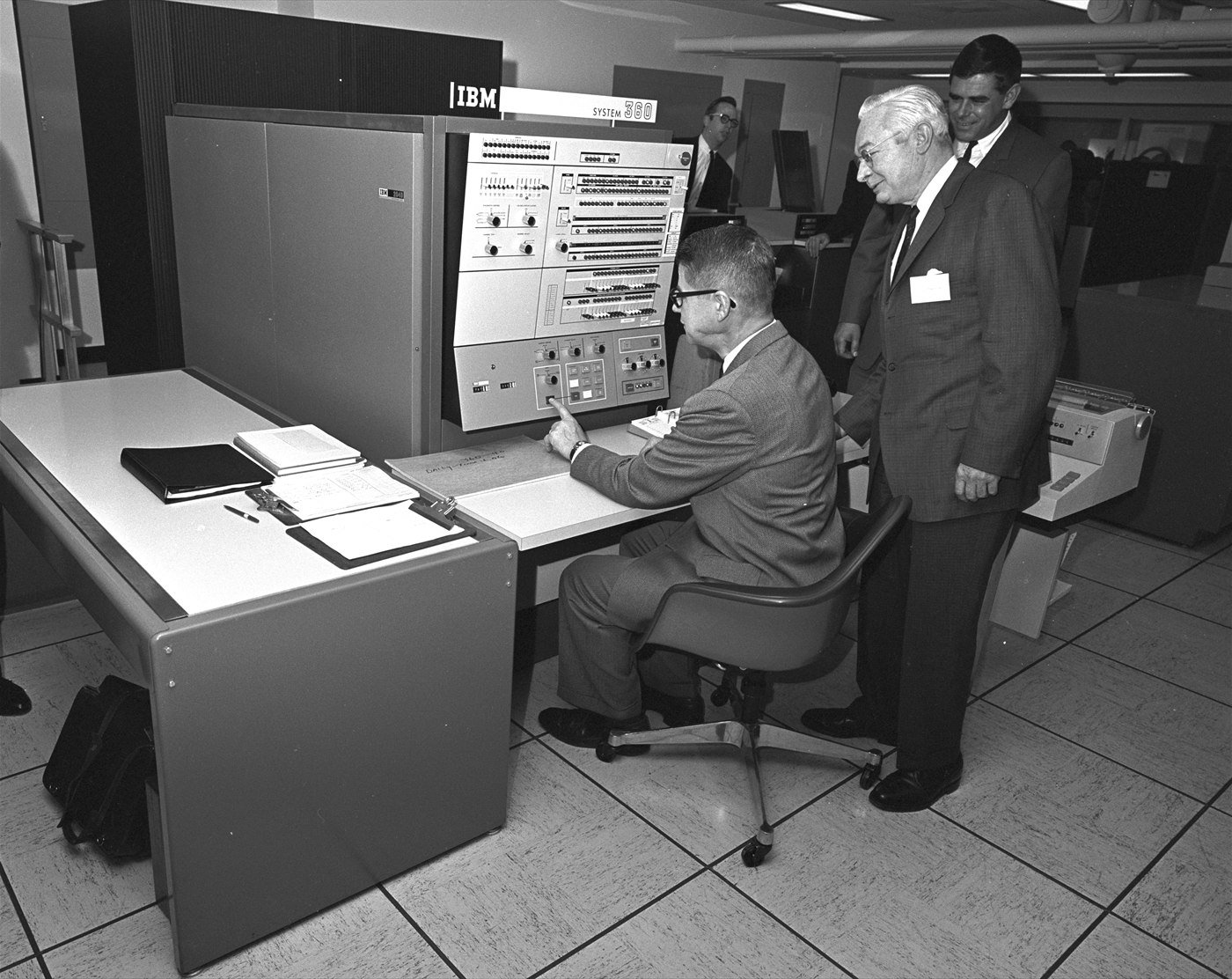
It worked. Customers could grow without starting again, and the idea of a compatible family of computers became the standard for the industry. Descendants of the System/360 are still sold; the latest mainframe, the z17, was released in 2025.
Success brought the government. In 1969 the US Justice Department filed an antitrust suit that ran for thirteen years before it was dropped. The same year IBM began charging separately for software and services instead of bundling them with its hardware — a change widely credited with creating the independent software industry.
The PC It Could Not Keep
On 12 August 1981 IBM launched the IBM Personal Computer, model 5150. Built quickly by a small team, it used an Intel processor and an operating system licensed from a young company called Microsoft — a deal told in full in this archive’s profile of Microsoft.
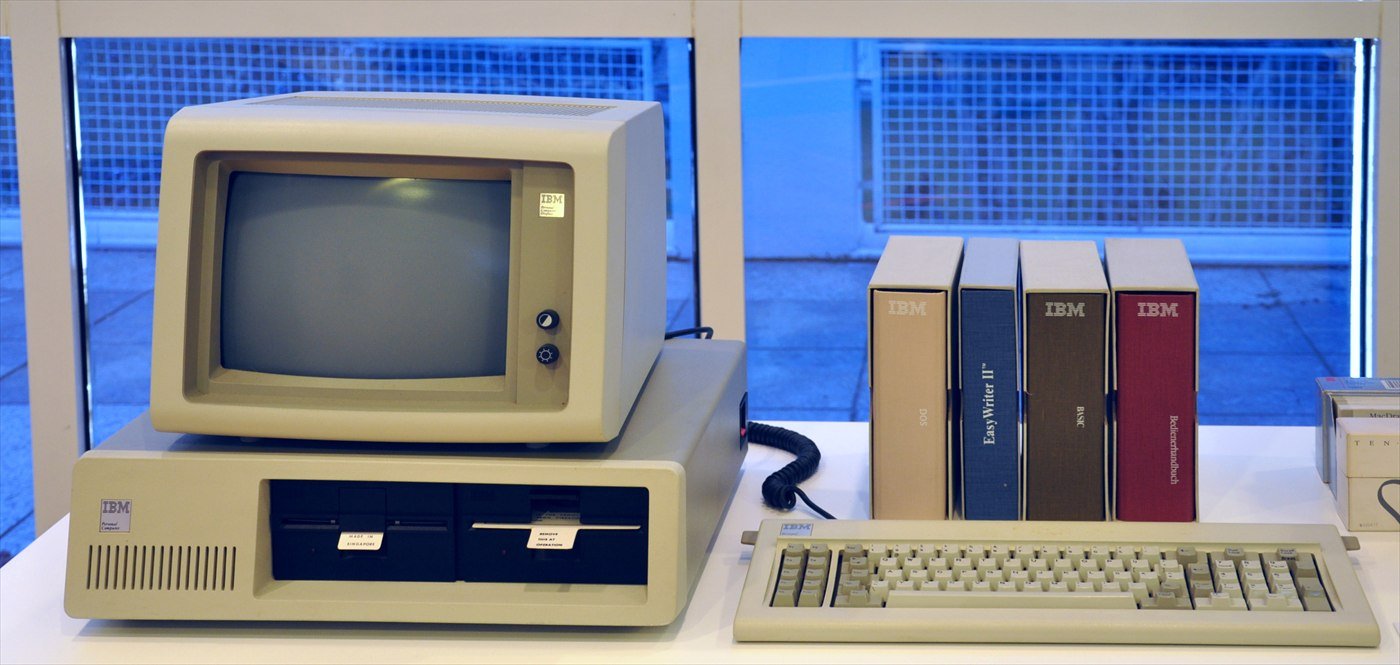
Because it was built from parts that others could buy, it could be copied. The first legal clone went on sale in June 1982, less than a year after the launch. Within a decade the industry standard still carried IBM’s name, while most of the profit went to the makers of the chips and the software, and to cheaper rivals.
IBM eventually left the business it had defined, selling its personal-computer division to China’s Lenovo in 2005.
An Outsider Keeps It Whole
Gerstner arrived in April 1993 as the first chief executive hired from outside the company. He relaxed IBM’s famous dress code and much else, but the substance was strategic.
He kept the company in one piece and turned it towards services — running and integrating other organisations’ technology, whoever had made it. A large customer, he reasoned, did not want to buy boxes; it wanted someone accountable for making everything work, and IBM was one of the very few companies with the breadth to offer that.
The recovery restored IBM’s profits and its prestige, and supplied its best-known public moments of the next two decades. In 1997 its Deep Blue computer beat the world chess champion Garry Kasparov in a match. In 2011 its Watson system won the American quiz show Jeopardy! against two of the show’s greatest champions.
From Chess to the Hybrid Cloud
Watson turned out to be better television than business. IBM marketed it as a system that would transform medicine and much else, the results fell well short of the promise, and the health unit built around it was eventually sold.
Under Ginni Rometty, chief executive from 2012 to 2020, revenue shrank for years as old businesses declined faster than new ones grew. Her largest move set up the next era: the purchase of the open-source software company Red Hat for $34 billion, announced in October 2018 and completed in July 2019.
Arvind Krishna, chief executive since 2020, has narrowed IBM around software, consulting and what it calls hybrid cloud — software that lets customers run their applications across their own data centres and the public clouds. In 2021 IBM spun off its infrastructure-services arm as a separate company, Kyndryl, with some 90,000 employees. In December 2025 it agreed to buy the data-streaming company Confluent for about $11 billion, completing the deal in March 2026.
In 2025 IBM reported revenue of $67.5 billion and net income of $10.6 billion, with about 264,300 employees. For 29 consecutive years to 2021 it received more US patents than any other business.
What Could Still Go Wrong
Three things are worth stating.
Growth. IBM has spent much of the past thirty years managing decline in some businesses while building others, and its revenue in 2025 was far below what it earned in the early 2010s. Red Hat and Confluent were bought growth, and bought growth has to be paid for.
Promises ahead of products. Watson showed how quickly a strong research story can become a credibility problem. IBM now speaks with similar confidence about AI and quantum computing. Both are serious programmes; neither is yet a large business.
Relevance. The biggest buyers of computing now go to Amazon, Microsoft and Google. IBM’s strategy rests on being the company that ties those clouds and its customers’ own systems together. That is a sound position, and a narrower one than IBM held for most of its history.
A company assembled by a financier in 1911 and held together by an outsider in 1993 has outlasted almost every rival it ever had. Its survival has never been an accident. It has never been guaranteed either.
Common Questions
When was IBM founded?
Who built IBM?
What was the IBM System/360?
Why did IBM lose $8 billion in 1993?
Does IBM still make personal computers?
What are IBM’s revenue and profit?
How This Was Written
Figures are as at the date of publication; corrections are welcome.
Photography is public domain or CC0 and is credited in the site’s image credits. Corrections: commissions@99founder.com.